FINDING HOPE... IN -PUNK
Rhymes With Camera || FOURTH MONDAY WHAT IFS || March 23, 2026


March 23, 2026 CONTENTS
• ESSAY: “Finding Hope… in -Punk”
• SQUATCHCON: My programming schedule
• LINK LOVE: -Punk in media
• BTRS BOOKS NEWS: Camp Crypticon III writing contest update
• AND SPEAKING OF HORROR & PUNK: “Some choice words from Josef B. Wilke”
• Message RWC
• Associations I support
• Declaration: Your Support is a Revolutionary Act
• More about Rhymes With Camera
• Contact
• Declaration: 100% Human Made
• Subscribe
FINDING HOPE… IN -PUNK
I’ve been playing around with the idea of the -punk genres.
The ones you’ve probably heard of include steampunk, splatterpunk, and cyberpunk. This genre hyphenate references works that transgress narrative expectations as a kind of conversation about boundaries, especially when linked to systems and technology.
There’s probably a better definition (like, maybe, “A to Z of Punk Genres,” an extensive list of categories and their definitions from Sorceror of Tea), but my informal one makes the most sense to me, however clunky it might be.
Let’s take a quick look at some of the more common -punk narrative labels.
Steampunk reimagines historical narratives (around the turn of the 20th century) often through the lens of science fiction and fantasy.
The Man in the High Castle (Philip K. Dick) suggests an alternate universe where the Nazis prevail during WWII. This reinvented history shows a divided United States and a terrifying new world order. (This work is technically a form of dieselpunk—a later cousin of steampunk—which spotlights the technological cultural reality of the 1940s.)
Splatterpunk pushes the boundaries of bloody, gory horror through the lens of violence, usually in reference to real-world horrors and depravities.
Exquisite Corpse (Poppy Z. Brite) is considered seminal splatterpunk, the darkly romantic story of two serial killers who develop a union over their shared desires that include violence, torture, and other unspeakable acts of inhumanity. It was inspired, in part, by the seeming emergence of real-life murderers like Jeffrey Dahmer.
Cyberpunk feeds the “what if?” dialog about digital life, highlighting the negative outcomes of misused tech and potentially evil machine sentience.
Ready Player One (Ernest Cline) presents a near-future dystopia where virtual reality gamers and hackers vie for a huge fortune. The protagonist plays to escape his impoverished life but ultimately seeks to use the winnings to make the world a better place. The ending may be optimistic, but the story’s setting remains pessimist about climate change.
Generally, these are purposefully pessimistic genres. They show what might have been or what could be if we took down the guardrails… and not with a “Happily Ever After” vibe.
THE EVOLUTION OF -PUNK
Since these earlier forms of -punk literature began to pop up, new ones have begun to emerge. The difference (at least to me) is that within them lies a kind of optimism that readers may be craving in our current collective political nightmare. I’m talking about solarpunk, lunarpunk, and hopepunk (with a nod to hopedark).
Solarpunk takes us on a different kind of “what if?” journey in which we discover, through narrative, what happens if the world gets climate change right and we learn to live in peaceful coexistence and community with nature.
A Psalm for the Wild-Built and its sequel, A Prayer for the Crown-Shy (Becky Chambers) highlight the possibility of a sustainable, eco-friendly world where the Nature-Human bond thrives, rewilding is valued, energy is renewable, and robots no longer control the landscape.
Lunarpunk has been called the yin to solarpunk’s yang: a hopeful journey shaped by gnostic spirituality, the healing integration of the human shadow, and the moonlit spaces where people alchemize the dark nights of their souls.
Avatar (the James Cameron movie franchise) champions these vibes: personal journeys within the context of collective problem-solving; they take place in twilight moments lit by both literal and figurative bioluminescence. Same solarpunk themes, but focused on personal “alchemy” as a mystical path to a better world.
Hopepunk, then, must mean by definition stories narrating and contemporizing the radical act of finding hope when the world is literally facing a core collapse (of society, energy, politics, biology, morality, tech).
Station Eleven (Emily St. John Mandel) shows readers what post-pandemic collapse can look like without violence, a concept that runs far afield of most end-of-the-world speculations, where it’s “kill or be killed.” Instead, her world gathers community to make art as part of the rebuild.
It’s here I’ll hat tip my writer pal, Valor, who labels their work as HopeDark, which I think of as horror’s version of hopepunk, with all the classic horror trimmings, but with outcomes that point to a safer, freer, more just world.
Ring Shout (P. Djèlí Clark) might fit this bill. What if the Ku Klux Klan were actually the servants of a racist demonic ritual enacted in real time in 1920s Georgia? This book follows the dark exploits of a team of female supernatural demon hunters with prophetic gifts and psychic skills.
MY OWN WORKS: A WELCOMED -PUNK INVASION
I find that my latest writing falls more and more easily into these -punk frameworks.
My story, “Three Best Practices for Helping Bottlenecked Earthbounds” (Interesting Times: A Hopepunk Anthology) illustrates how the living can help transfer the glut of war-zone lost souls who haven’t “gone to the light” through simple acts in the community.
“Flat Earth” (Quibble Lit) explores a lucid dreamer’s compassionate experience with a person in the astral plane who believes the Earth is flat.
Of my unpublished/unproduced work:
My novel-in-progress, Eminent Domain, follows a former healthcare worker who takes over her grandmother’s neglected farm after fleeing the PTSD nightmare of the COVID-19 front lines. She discovers that not all ghosts or hauntings are scary… and many of them bring healing.
Another N-I-P, The Flare, shows what could happen if a handful of neurologically disabled people in a small community survive a worldwide apocalyptic event in spite of their challenges. Might the meek truly inherit the earth? I say, it’s not all that far-fetched.
I recently unearthed a short story, “Some Early Spring Pruning,” in which a peace-minded poet learns how to literally cut the cord that links her to a toxic, narcissistic workshop classmate. It’s no less harsh than pruning dead branches off living plants; in fact, it’s liberating.
Another short story, “The Rabbit Holes of Wonderland,” shows a terribly dystopian future driven by the terrorism of rogue robots… until a grandmother, her adult son, and her grandchild Alice, experience a violent encounter that ultimately frees them to a different plane of existence.
In my short script, “Snapdragon Season,” a pagan woman finds a skull in her garden. She investigates using occult practices to discern who it belongs to and how to free its spirit—all while living under the watchful eye of a well-meaning, very orthodox Christian neighbor.
I just wrote “The Pact.” In it, the protagonist has a peculiar experience with friendly strangers at a bonfire party, where she unknowingly “draws down the moon” and makes a protection pact with it. The new moon ends up following her home in order to fulfill their arrangement.
There is a kind of optimism creeping into my dark stories that surprises even me! But I’m going to keep rolling with it because, as they say, you ought to write the things you want to read, and like everyone else I know, I could use some optimism right now.
🌠ARE YOU GOING TO SQUATCHCON?
Check out my programming schedule!
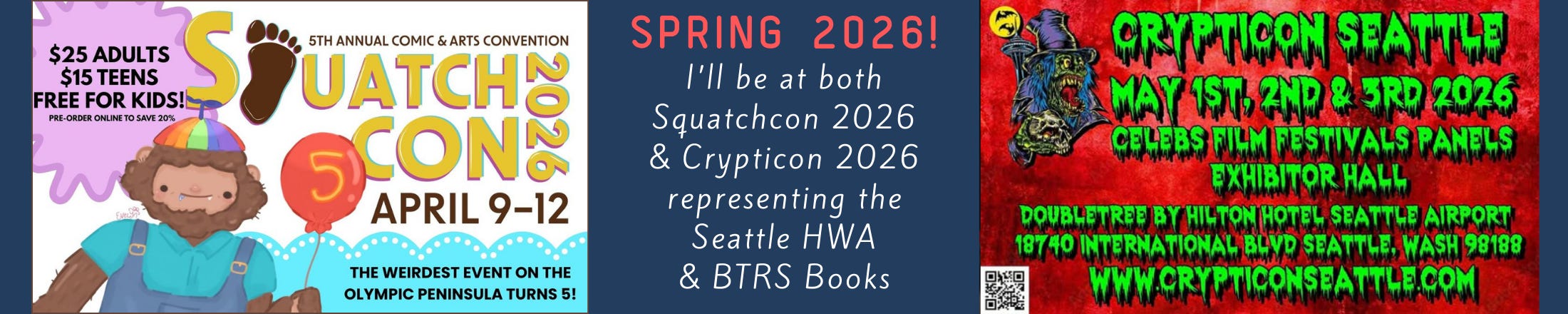
Yes, there’s such a thing as a convention devoted to our beloved Bigfoot, and I’ll be participating in the writers’ program track with several other regional authors in April.
SquatchCon takes place from Thursday April 9 to Sunday April 12 at the Vern Burton Community Center in Port Angeles, WA, making it accessible to Canadian visitors via the Black Ball Ferry as well as folks driving in from all over Washington state. If you’re coming from the Bainbridge Island or Kingston ferries, allow yourself two hours to make that part of the trip (maybe another 30 minutes on Saturday and Sunday morning because tourism traffic is a real thing).
This ComiCon-styled event is billed as a low-stress, family-friendly, accessible convention featuring gaming, arts, cosplay, writers’ programming, workshops, even a friendly ‘Squatch mascot. Register now or get tickets at the door, with several packages available.
Here are my particular programming slots, in case you’ll be there and want to say hello!
“ ‘BECAUSE I COULD NOT STOP FOR BIGFOOT’
MADLIBS POETRY”THURS APR 9 || 630-730p || Meeting Room 1
Regional author and poet Tamara Kaye Sellman leads a wacky, MadLibs-inspired poetry building workshop using our beloved Sasquatch as a central figure.
Hear some real poems dedicated to PNW cryptids, then venture to write some of your own after a sample round.
Choose between Bigfoot, the Kraken, the Tree Octopus, the Lady of the Lake; or, Northwest-ify your favorite classic creature (Hint: The Hurricane Ridge Were-Marmot).
If there’s time, we’ll share a few! Fun for all ages; poetry templates and pencils provided! No poetry experience necessary.
“I’VE FINISHED MY DRAFT… NOW WHAT?”
SAT APR 11 || 10-11a || Meeting Room 2
Long before you ever submit to agents and publishers, of if you go the indie route, hit publish on your distribution platform of choice, there are many, many steps towards getting your creative work to where you want to share it with the entire universe.
It can be very intimidating, and many authors never progress past this point. This panel is determined to help you avoid this stall-out.
We hope that, throughout discussion and your questions, we can help all of you authors out there get those stories out of your own desk drawers and onto the desks of those who will take them to the next level, whether that be freelance editors, beta readers, agents, publishers, or a reliable and objective group of critique partners.
With Tamara Kaye Sellman, Kat Richardson, Jen Flanagan; moderated by Brian Blackwood
“TRADITIONAL VS. INDIE PUBLISHING”
SUN APR 12 || 10-11a || Meeting Room 2
Despite the ever-evolving landscape of the creative industries, one question often remains at the forefront of emerging author’s minds: do I go indie or traditional for my book?
In this panel, we will explore the benefits, boons, and pitfalls of each publishing method, the difficulties and rewards inherent in each, and the paths to publishing success down each one.
With Kendare Blake, Tamara Kaye Sellman, Brian Blackwood, Kat Richardson; moderated by Lish McBride
“IS THIS THE FORMAT FOR MY STORIES?”
SUN APR 11 || 1115a-1215p || Meeting Room 2
Whether you prefer live theater, film, prose, poetry, or music, some stories are just a certain fit for a particular medium.
But how do you know which medium would be the best fit for the story you’re creating?
In this panel, we’ll analyze the specific angles you can use to objectively analyze the story you want to tell and put it in the right format for success.
We will also talk about the various considerations and limitations across various creative formats.
With Erik Keevan, Josh Cutchin, Kendare Blake, Lish McBride, Cammry Lapka; moderated by Tamara Kaye Sellman
💡LINK LOVE: -Punk in Media
Want to learn more about -punk? Check out these links!
Keep in mind that definitions of the -punk genre/subgenre are still works in process; much of lunarpunk, for instance, is found more as an aesthetic than as a fully formed genre, while some might argue it’s simply the individuated shadow side of solarpunk.
The following links are tremendous food for thought, all the same.
Authors
🔗Brightflame
🔗Rebecca Campbell
🔗Becky Chambers
🔗Cory Doctorow
🔗Amar el-Mohtar
🔗Ruthanna Emrys
🔗Ursula K. LeGuin
🔗Marge Piercy
🔗Susan Kaye Quinn
🔗Kim Stanley Robinson
🔗Alexandra Rowland
🔗Lauren C. Teffeau
🔗Jeff Vandermeer
🔗Francesco Verso
🔗Martha Wells
🔗Andy Weir
Publications
🔗Solarpunk Magazine
🔗Bioluminescent: A Lunarpunk Anthology
🔗Interesting Times: A Hopepunk Anthology
Movies
🔗IMDB Solarpunk list
Podcasts
🔗Demand Utopia
🔗Lost Terminal (dramatized hopepunk sci-fi)
🔗Lunarpunk Dreams
🔗Solarpunk Now!
📙BTRS BOOKS NEWS: Camp Crypticon III awards announced this May!
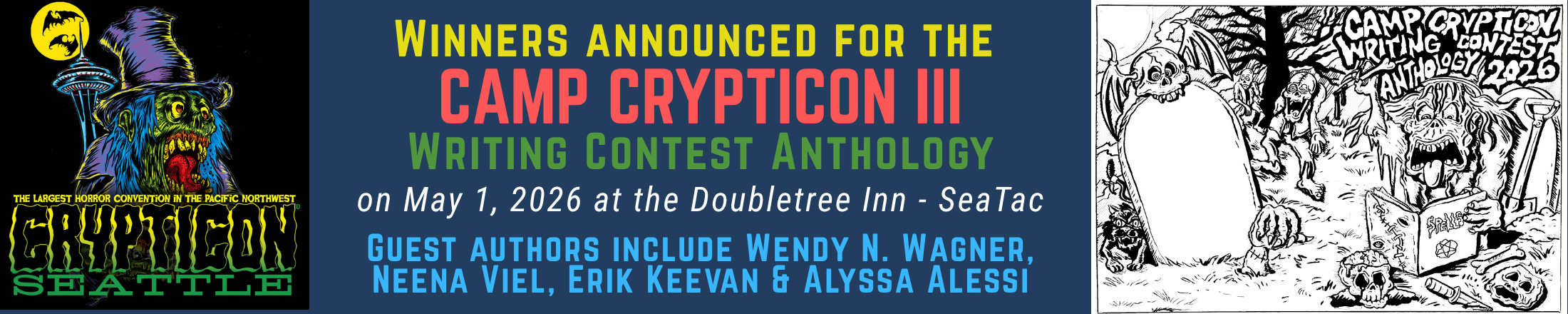
Clay Vermulm and I are putting the finishing touches on the latest Camp Crypticon writing contest anthology, which BTRS Books will launch this coming May at Crypticon Seattle (May 1-3).
Guest authors for the anthology include Wendy N. Wagner, Neena Viel, Erik Keevan & Alyssa Alessi, with a foreword from Josef B. Wilke.
We are pleased to announce the finalists (in alphabetic order):
Brian Blackwood
Prima Changwatchai
Elias Constant
Dr. Jaymi Goetze
Carson King
K.T. Margrave
Congratulations to all of the finalists! We look forward to meeting them and announcing the prizes at the convention!
AND SPEAKING OF HORROR & PUNK
Some choice words from Josef B. Wilke
I recently put finishing touches on the manuscripts that are heading, as we speak, to production for the latest Camp Crypticon anthology.
One thing I really love about this book is the Foreword written by author Josef B. Wilke. He makes some fantastic connections between horror writing and punk culture that I simply can’t stop thinking about.
To wit, here are some samples shared with his permission:
“NIGHT OF THE LIVING DEAD has to be the most punk movie ever made.
George A. Romero made a transgressive masterpiece still influencing horror to this day all in a backyard with a ragtag camera crew and a cast of no-names at the time.
That is what DIY is all about.
…I dare you to name a genre more authentic than horror. …Only you can’t. Because one doesn’t exist. Horror has to be honest in order to work.
Sure, the monsters are pure fiction. But the subject matter that horror tackles demands brutal honesty in order for the audience to take it seriously.
It’s the same way punk rejects industry plants trying to make a quick buck off aesthetics. Audiences want it raw. We want it real. Authenticity is our only demand.
If you can’t make that low bar, then you’re better off playing hair metal.”
—Josef B. Wilke, Camp Crypticon III Foreword
Love it! When you pick up the newest edition of Camp Crypticon this year, don’t overlook his energizing introduction!
Thinking more broadly…
I truly think we are in a cultural minute where we’re (globally) rethinking how we look at and interact with each other and the world. This includes shifts toward the radical act of truthtelling through art in all forms of media made necessary by the rise of authoritarianism.
Y’all, if you haven’t already figured this out: artists are the secret soldiers in the wars on human and civil rights. If you’re fried from doomscrolling, go find some powerful artist/maker accounts pushing activism and resistance. You’ll be blown away at how energized you’ll be after literally seeing the writing on the wall… words meant for you and me and human beings everywhere being held hostage by the ultra wealthy.
Zines are also having a moment, indie film is taking up more space in people’s watchlists, and mainstream folks are craving physical media like I haven’t really witnessed before. Sweet little families hanging out down at the punk rock flea market are, in their own way, a delicious little act of rebellion.
Yes, we’re living in interesting times… does that mean it has to be all bad? I think not!🤘🏽[And that, my friends is why they call it H O P E -punk!]
April is nigh!
Next week, for a change of pace, I’ll make a seasonal reveal of greenhouse developments, share a recipe, and make deep thoughts about this year’s growing season… and yes, there will be pictures. See you then!
⸙ Tamara
🔗Seattle Chapter, Horror Writers Association
🔗Dread Writers Society
🔗Authors Against Book Bans WA branch
🔗Northwest Film Forum
🔗Seattle Film Society
🔗Bainbridge Island Film Group/Emergence Films
MORE ABOUT RHYMES WITH CAMERA
🔗Publication credits
🔗Rhymes With Camera calendar 2026
🔗Media kits (Intention Tremor, Cul de Sac Stories, Rain Shadows)
🔗Sellman Shelf BookShop
🔗Tamara Kaye Sellman: Social Media
🔗Tamara Kaye Sellman: Linktr.ee
CNT: Tamara Kaye Sellman
321 High School Road NE
Ste. D-3, PMB 204
Bainbridge Island, WA 98110
www.rhymeswithcamera.com (homepage and blog)